
Spaced Repetition Made Simple: 5 Easy Steps to Learn Vocabulary That Actually Sticks
Spaced repetition is a method for reviewing what you have learned right before you are about to forget it, instead of cramming and forgetting everything a few days later. If you have ever copied out a long word list, studied it late into the night and remembered only a handful a week later, the problem is not your memory. It is how you review.
This guide briefly explains why spaced repetition works, then walks through 5 steps to learn vocabulary that sticks using paper cards or a free app, plus a sample review schedule for beginners.
Contents: spaced repetition
1. What is spaced repetition, and why does it work?
In the late 19th century, psychologist Hermann Ebbinghaus described the “forgetting curve”: new information fades quickly in the first few days unless you review it. Each review slows that forgetting and makes the memory more durable.
Spaced repetition takes advantage of exactly that. Instead of reviewing ten times in one evening, you review five times spread over a month, with each gap longer than the last. As Wikipedia’s overview of spaced repetition notes, it is a widely studied and widely used learning technique, especially for languages.
Two core principles
- Self-testing (active recall): Try to remember the answer before you look, instead of just rereading.
- Expanding intervals: If you remember, the next review comes later; if you forget, it comes sooner.
2. 5 steps to use spaced repetition to learn vocabulary
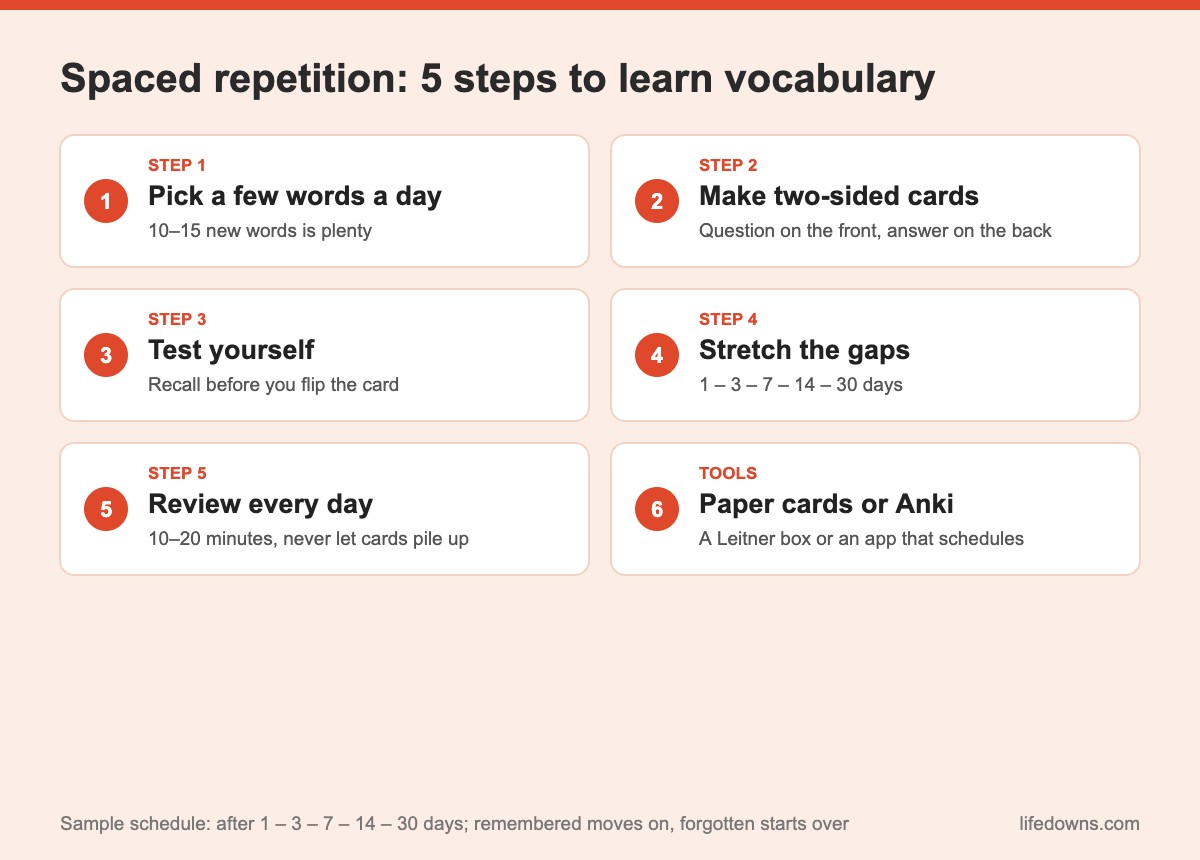
Step 1: Pick a small number of new words each day
Start with 10–15 words a day. It sounds like very little, but after a month you will have a few hundred words reviewed the right way. Learning too many at once makes your review pile explode after a week and is a quick route to giving up.
💡 Quick tip: Prioritize words you meet in shows, articles or your daily work. Words with real context are much easier to remember than words from a dry list.
Step 2: Make two-sided flashcards
On the front, write the word and a short example sentence. On the back, write the meaning and pronunciation. Keep one idea per card. The shorter the card, the faster your reviews.
Step 3: Test yourself before flipping
This is the step most people skip. Look at the front, try to say the meaning or use the word in a sentence, and only then flip the card to check. That effort to recall is what strengthens memory, not rereading.
Step 4: Gradually stretch the gaps
A simple beginner schedule: review after 1 day, 3 days, 7 days, 14 days and 30 days. If you get a card right, it moves to the next gap. If you forget, it goes back to the first one. Apps like Anki calculate this schedule for you based on how well you know each card.
Step 5: Review for 10–20 minutes every day
The power of spaced repetition comes from consistency. Skip a few days and due cards pile up. Attach your reviews to a habit you already have: your morning coffee, the bus ride or just before bed.
3. Paper cards or an app: which tool should you use?
A paper box with the Leitner system
Get a box with five sections. New cards go into section 1 and are reviewed daily. Correct answers move a card to the next section, reviewed less often (for example section 2 every other day, section 3 weekly). Wrong answers send it back to section 1. This suits people who like writing by hand and want less screen time.
Flashcard apps
Anki (free on desktop and Android) and many other flashcard apps schedule reviews automatically, sync across devices and let you add audio and images. They are ideal if you learn a lot of words or want to review on your phone anywhere.
💡 Quick tip: Make your own cards instead of downloading someone else’s deck. Writing the card is itself a round of learning.
4. Mistakes that make spaced repetition less effective
- Reading without testing: Flipping the card immediately without trying to recall is basically just rereading.
- Cards that are too long: A card with a whole paragraph is hard to review and easy to “cheat” on.
- Adding too many new cards: Reviews grow fast and you may quit within two weeks.
- Skipping days in a row: A backlog makes the next session overwhelming.
5. The bottom line: spaced repetition means study less, remember longer
Spaced repetition does not ask you to study more hours, just to study at better moments. Fifteen minutes a day with a few vocabulary cards, kept up for a few months, usually beats exhausting last-minute cram sessions by a wide margin.
Sample review schedule for beginners
| Review | When | If you remember | If you forget |
|---|---|---|---|
| 1st | After 1 day | Move to 3 days | Review again tomorrow |
| 2nd | After 3 days | Move to 7 days | Back to 1 day |
| 3rd | After 7 days | Move to 14 days | Back to 1 day |
| 4th | After 14 days | Move to 30 days | Back to 1 day |
| 5th | After 30 days | Review rarely or retire | Back to 1 day |
Note: This is a reference schedule; apps like Anki adjust intervals automatically based on how well you remember.
A few final tips
- Add example sentences: Words with context are easier to remember and use.
- Say it out loud: You practice pronunciation and remember better.
- Delete useless cards: Very rare words can go to lighten the load.
- Track progress: Note how many words you learn each week to stay motivated.
More from our Education section: Finished the book and remember nothing? Try three-line notes and Study for exams without cramming.
FAQ about spaced repetition
What is spaced repetition?
Spaced repetition is a way of reviewing material at increasing intervals, for example after 1 day, 3 days and a week. Reviewing right before you forget strengthens memory far more than cramming everything in one sitting.
How many new words should I learn per day?
For beginners, around 10–15 words a day is manageable. Your daily reviews grow over time, so learning a little consistently beats learning a lot and giving up.
How do I use spaced repetition without an app?
Use a box of paper cards with the Leitner system: split cards into 4–5 sections, move correctly answered cards to a section you review less often, and send missed cards back to the first section.
Is spaced repetition only for languages?
No. It works for anything you need to memorize, such as formulas, technical terms, historical dates or exam questions.
How are you learning vocabulary right now? Leave a comment and share your favorite app or memory trick! Save this post and start your spaced repetition schedule today. 📚🧠