
Fridge Energy Saving: 7 Simple Ways to Cut Your Electricity Bill While Keeping Food Fresh
Fridge energy saving does not require buying an expensive new model. Your refrigerator runs 24 hours a day, 365 days a year, so a few small bad habits quietly push up your electricity bill, and a few simple fixes can bring it down every single month.
This guide covers 7 practical fridge energy saving tips that keep your food fresh: from setting the right fridge temperature and choosing where the fridge sits, to checking the door seal, packing food smartly and doing basic maintenance.
Contents: fridge energy saving
1. Why your fridge uses more power than you think
Unlike an air conditioner or water heater that runs for a few hours, a fridge works day and night. Its compressor cycles on and off to hold the temperature inside. Every time the door stays open too long, the seal leaks or the coils get dusty, the compressor has to run longer.
The good news is that most of the causes come down to everyday use. You do not need a new fridge to see a difference, just a few adjustments below.
2. 7 fridge energy saving tips that work
Tip 1: Set a sensible fridge temperature
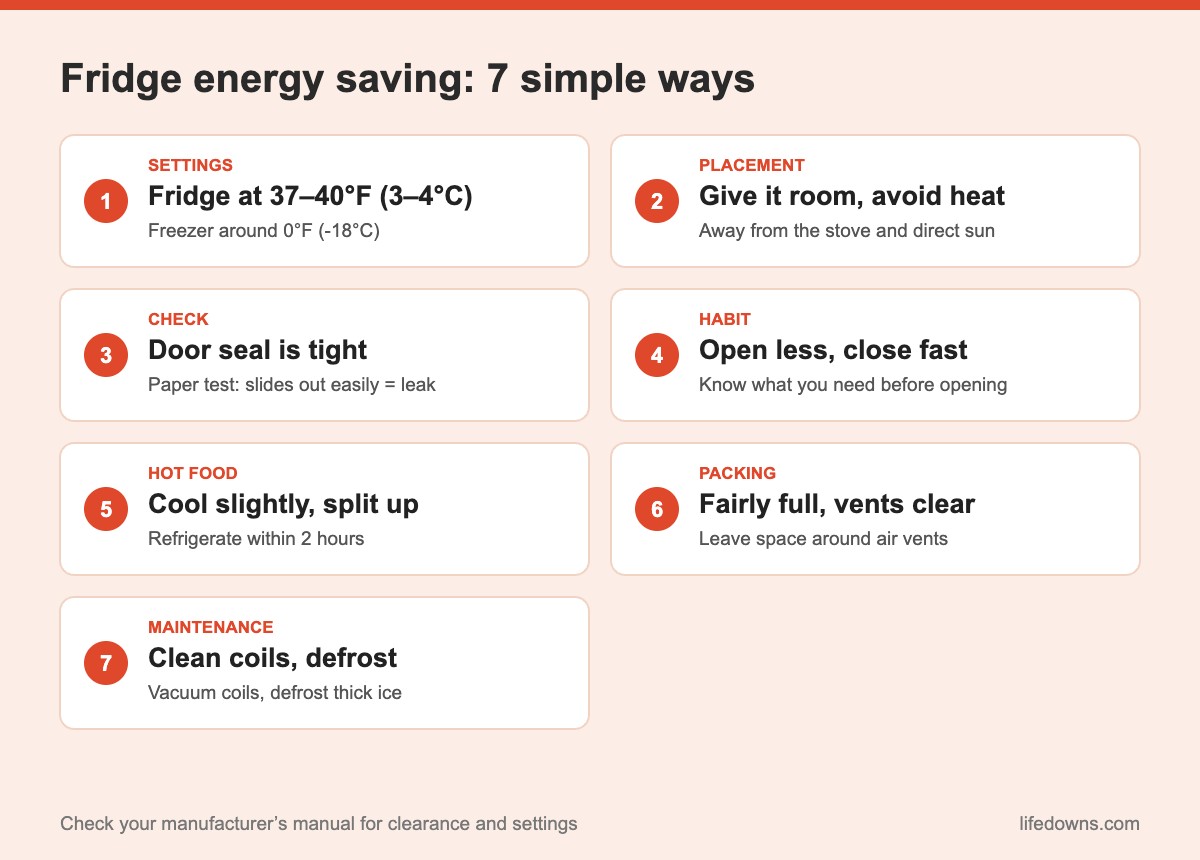
Many households turn the dial to maximum, thinking colder is always better. In reality, about 37–40°F (3–4°C) for the fridge and 0°F (-18°C) for the freezer is enough to store food safely. According to ENERGY STAR guidance on refrigerators, keeping your fridge at the recommended temperature rather than colder is one of the simplest ways to cut energy use.
💡 Quick tip: If your fridge only has a 1–7 dial instead of degrees, put a small thermometer in the fridge compartment and adjust gradually until it reads about 37–40°F (3–4°C).
Tip 2: Give it breathing room and keep it away from heat
The condenser coils at the back or sides need space to release heat. A fridge pushed against the wall, next to a gas stove or in afternoon sun makes the compressor work harder. Check your manual for the recommended clearance and keep the area around the fridge open.
Tip 3: Check the door seal
A hardened, torn or dirty rubber gasket lets cold air escape constantly. Easy test: close the door on a sheet of paper. If you can pull it out with no resistance, the seal may be leaking at that spot. Clean the gasket with warm water, and replace it if it still leaks.
Tip 4: Open the door less and close it quickly
Every time the door opens, cold air spills out and warm air rushes in. Decide what you need before opening, grab several ingredients at once while cooking, and teach kids not to stand there staring inside. This small habit adds to your fridge energy saving every day.
Tip 5: Don’t put a whole pot of hot food inside
A pot of soup straight off the stove raises the temperature of the whole compartment and keeps the compressor running. Let food cool slightly, split it into small, shallow containers and then refrigerate. For food safety, do not leave cooked food at room temperature for more than two hours.
Tip 6: Keep it fairly full, but don’t block the vents
An almost empty fridge has more air to cool, while an overstuffed one blocks cold air from circulating. Fill it reasonably, leave space around the air vents inside, and use lidded containers to hold moisture and prevent odors.
Tip 7: Clean the coils and defrost regularly
Every few months, unplug the fridge and use a soft brush or vacuum to clean the condenser coils at the back or underneath. If your freezer does not defrost automatically, defrost it when the ice builds up, because thick frost makes cooling less efficient.
💡 Quick tip: Pair coil cleaning with your regular fridge clear-out so you never forget it.
3. Myths that make your fridge use more electricity
- “Unplug it at night to save power”: It has to work hard to cool down again, saving almost nothing while risking spoiled food.
- “Colder keeps food longer”: Colder than needed just wastes energy and can even freeze and damage vegetables.
- “Cover it up to keep it clean”: Throwing a cloth over the top or stacking things on vents traps heat.
- “Bigger is more comfortable”: An oversized fridge spends energy cooling empty space.
4. Buying a new fridge: how to choose an efficient one
If your fridge is more than ten years old, runs loudly and feels hot along the sides, it may be time to think about replacing it. When you shop, look at:
- Energy label or ENERGY STAR certification: Higher ratings mean lower running costs.
- Estimated yearly energy use: The kWh/year figure makes it easy to compare models.
- Inverter compressor: It adjusts its speed instead of switching on and off constantly.
- The right size: Choose a capacity that matches your household.
5. The bottom line: fridge energy saving starts with small habits
You do not need to spend much to make your fridge more efficient. A sensible temperature, some breathing room, a tight door seal, smart packing and regular cleaning are enough to make it run quieter, last longer and cost less.
Summary table: what to do and when
| Task | How often | Time | Impact |
|---|---|---|---|
| Check fridge and freezer temperature | Each season | 5 minutes | High |
| Check where the fridge sits | Once | 10 minutes | High |
| Paper test on the door seal | Every few months | 5 minutes | Medium – high |
| Clean the condenser coils | Every few months | 15 minutes | Medium |
| Defrost (manual models) | When ice builds up | 30–60 minutes | Medium |
Note: Actual savings depend on the age and size of your fridge and how your household uses it.
A few final tips
- Thaw in the fridge: Frozen food thawing in the fridge also helps keep it cool.
- Label with dates: You know what to eat first and spend less time with the door open.
- Going away for long: Clear out perishables and adjust settings following your manual.
- Watch your bill: Compare usage before and after the changes to see the effect.
More from our Energy section: Choosing LED bulbs: look at lumens, not watts and High electricity bill in the hot season: what to adjust.
FAQ about fridge energy saving
What fridge temperature saves energy but keeps food safe?
Around 37–40°F (3–4°C) for the fridge and 0°F (-18°C) for the freezer is the commonly recommended range. Going colder uses more electricity without keeping food fresh much longer.
Should I unplug the fridge at night to save electricity?
No. When you plug it back in, it has to work hard to cool down again, so you save almost nothing, and food can warm up to unsafe temperatures.
How much space should a fridge have around it?
Each manufacturer lists its own clearance in the manual, usually a few centimeters at the sides and back. The key is not to push it against the wall, next to the stove or into direct sun, so the coils can release heat.
What should I look for in an energy-efficient new fridge?
Check the energy label or ENERGY STAR certification, the estimated yearly kWh, whether it has an inverter compressor, and choose a size that fits your household.
What temperature is your fridge set to right now? Leave a comment and share your household’s energy-saving tricks! Save this post so you can check your fridge this weekend. ❄️💡