

Studying for Exams Without Cramming: Split It Up and Review at the Right Time
The best way to study for exams is little and often, not all at once. You stay up until 2 a.m. the night before the exam and walk in remembering quite a lot. Ask yourself the same questions a week later and most of it is gone. Cramming gets you through the test. It does not leave much behind.
The alternative is to split the material into small pieces and review each piece several times, with gaps in between. This is called spaced review. It sounds simple. Few people stick with it because it means planning early.
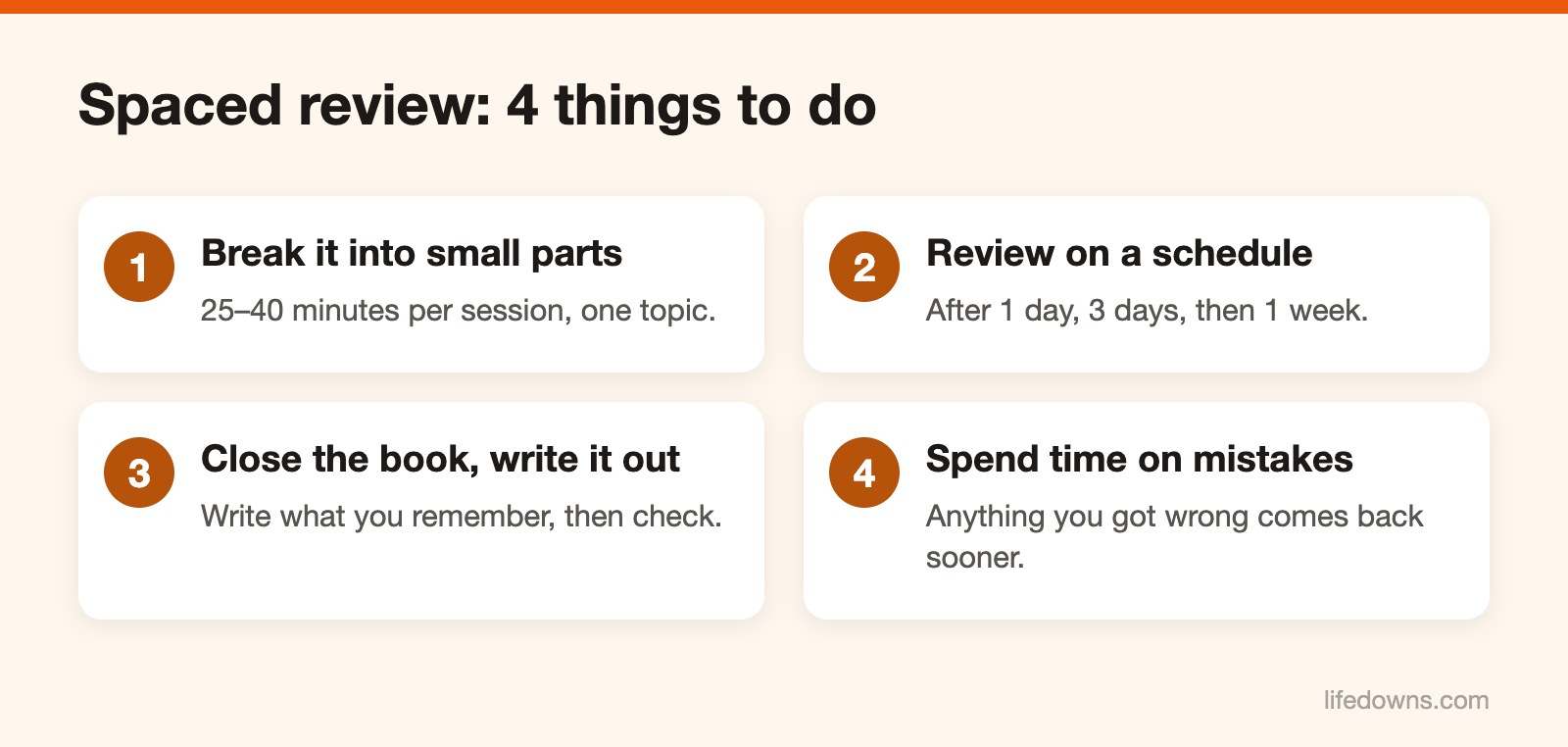
Table of Contents: study for exams
Why cramming fades fast
When you reread the same page in one sitting, the words start to look familiar and you assume you know them. Familiar is not the same as remembered. You find the gaps only when you have to write it out without looking.
Reviewing a few days later works differently. By then you have forgotten part of it and have to work to recall it. That effort is what makes the material stay.
A sample plan for the last 3 weeks
- Week 1: learn one new topic a day. The next evening, spend 10 minutes reviewing the previous day’s topic.
- Week 2: keep learning new material, and also review topics from 3 days ago and 1 week ago.
- Week 3: stop adding new material. Do practice papers, mark every wrong answer and review exactly those parts.
- Last two days: light review of your weak spots, and a full night’s sleep.
Test yourself instead of rereading
Rereading notes feels productive, but it works less well than testing yourself. Close the book, take a blank sheet and write down everything you remember about the topic. Then open the book, check, and mark what you missed.
Flashcards work too. Question on the front, answer on the back. Paper is fine, or use an app such as Anki or Quizlet. Anki schedules the cards for you: cards you get wrong come back sooner, easy ones come back later. To study for exams this way, start a few weeks earlier. When you study for exams in small pieces, you also sleep better before the test. Once you study for exams like this, cramming feels unnecessary.
Common mistakes
- Cards that are too long. One card, one question.
- Reviewing only what you already know because it feels good. The parts you get wrong are the parts to review.
- Missing a few days and quitting. If you fall behind, do a short catch-up session. No need to restart.
Spaced review does not cut your study hours. It spreads the same hours over more days. Starting one week earlier than you normally would is enough to notice the difference.
Next exam, try to study for exams using these steps. Learn more about spaced repetition, or read about learning after work.