
The Pomodoro Technique: 5 Simple Steps to Study and Work with Better Focus, 25 Minutes at a Time
The Pomodoro Technique is one of the simplest and most popular time management methods for students and working people. Instead of sitting down determined to “study for three hours straight” and picking up your phone after twenty minutes, you split your time into short sessions of full focus, separated by deliberate breaks.
This guide explains what the Pomodoro Technique is, walks through 5 steps to study with focus, and covers how to handle distractions and which variations suit different kinds of work.
Contents: the Pomodoro Technique
1. What is the Pomodoro Technique?
The Pomodoro Technique was developed by Francesco Cirillo in the late 1980s. The name comes from the tomato-shaped kitchen timer (pomodoro is Italian for tomato) he used as a university student. According to Wikipedia, the method breaks work into intervals, traditionally 25 minutes long, separated by short breaks.
The core idea is simple: focusing for a short time is far easier than focusing for a long time. Knowing a break is only minutes away makes it easier to start and harder to procrastinate.
What makes up one Pomodoro cycle?
- 4 work sessions of about 25 minutes each.
- 3 short breaks of about 5 minutes between sessions.
- 1 long break of 15–30 minutes after the fourth session.
2. 5 steps to use the Pomodoro Technique
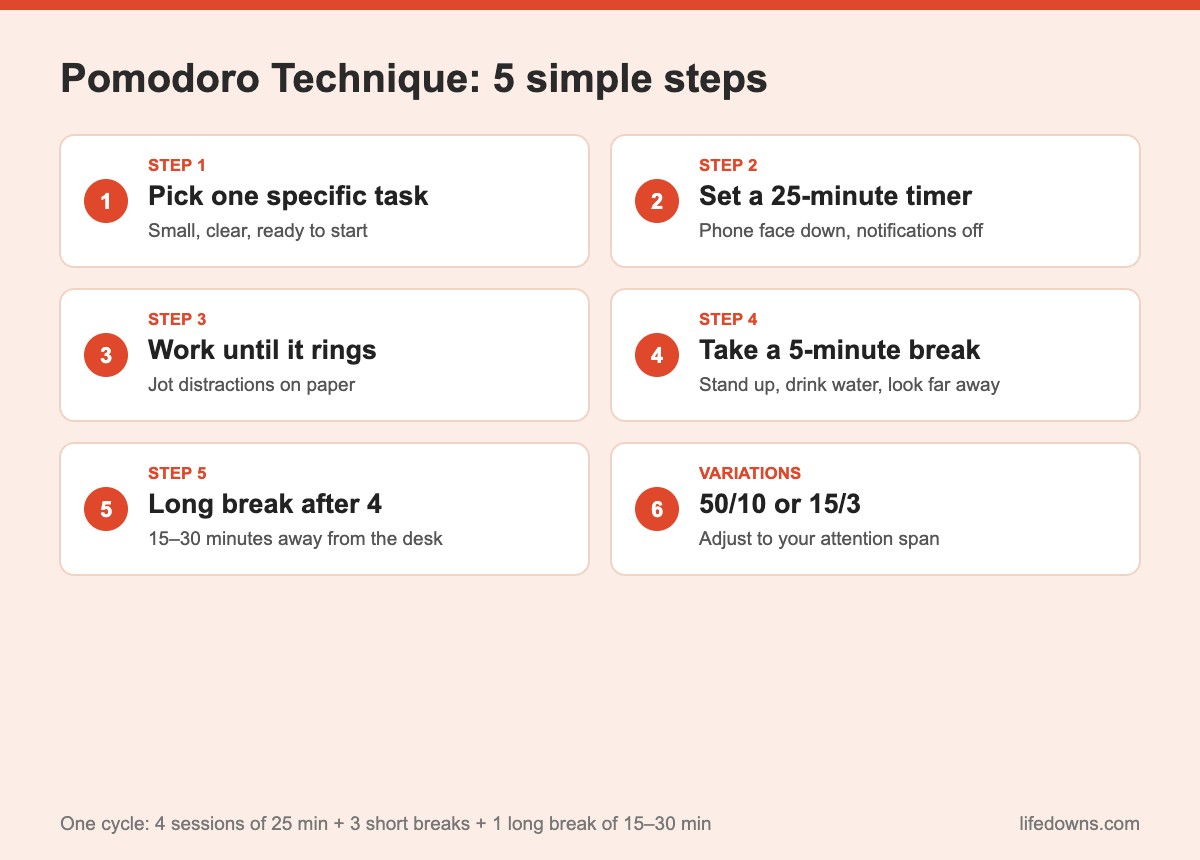
Step 1: Pick one specific task
Write down one clear task you can start right away, such as “do 10 multiple-choice questions from chapter 3” rather than “revise math”. The more specific the task, the easier it is to focus.
Step 2: Set a 25-minute timer
Use a kitchen timer, an app or your phone’s clock. Put the phone face down, turn off notifications and close unrelated tabs. It is a small promise to yourself: for these 25 minutes, only one thing.
💡 Quick tip: Leave your phone in another room or in a drawer while you study. Simply not seeing it makes you far less likely to pick it up.
Step 3: Work until the timer rings
When a thought pops up like “I need to message a friend” or “let me look this up”, jot it on a piece of paper beside you and return to the task. You will deal with that list during the break.
Step 4: Take a 5-minute break
When the timer rings, stop, even if you are on a roll. Stand up, stretch, drink some water and look into the distance to rest your eyes. Avoid social media, because five minutes easily becomes thirty.
Step 5: After four sessions, take a long break
After the fourth session, rest for 15–30 minutes: take a walk, have a snack, chat with someone. The longer break lets your brain recharge before the next cycle.
3. How to handle interruptions
Interruptions are inevitable, especially when studying at home or working in an office. Two easy rules:
- Not urgent: write it down, deal with it after the session and carry on.
- Must stop: end that session and start a new one from scratch when you come back.
💡 Quick tip: Tell family or colleagues, “I’m focusing for 25 minutes, I’ll get back to you right after.” Most people are happy to wait.
4. Variations of the Pomodoro Technique
Twenty-five minutes is not a fixed rule. Adjust it to your attention span and the kind of work:
- 15 minutes on / 3 minutes off: for beginners, younger students or tired days.
- 25 minutes on / 5 minutes off: the standard, suitable for most people.
- 50 minutes on / 10 minutes off: for deep-focus work like writing, coding or practice exams.
Combine Pomodoro sessions with memory methods like spaced repetition and you will both focus better and remember longer.
5. The bottom line: the Pomodoro Technique makes starting easier
The real power of the Pomodoro Technique is not the number 25, but that it helps you begin. By committing to just 25 minutes, the hardest part, sitting down, is already solved. Repeat a few sessions every day and you will notice better focus and less fatigue.
Summary table: Pomodoro variations
| Variation | Work | Short break | Best for |
|---|---|---|---|
| Gentle | 15 minutes | 3 minutes | Beginners, younger students |
| Standard | 25 minutes | 5 minutes | Most people |
| Deep focus | 50 minutes | 10 minutes | Writing, coding, practice exams |
| Long break | After 4 sessions | 15–30 minutes | Applies to every variation |
Note: These are suggestions; experiment to find the rhythm that suits you.
A few final tips
- Plan your sessions: For example, “6 Pomodoros for math today”.
- Count completed sessions: Tick them off on paper to see progress.
- Batch small tasks: Group messages and email into one session.
- Don’t overdo it: On tired days, do fewer sessions instead of none.
More from our Education section: Spaced repetition made simple and Study for exams without cramming.
FAQ about the Pomodoro Technique
What is the Pomodoro Technique?
The Pomodoro Technique is a time management method developed by Francesco Cirillo. It breaks work into focused sessions of about 25 minutes, separated by 5-minute breaks, with a longer break after four sessions.
Does it have to be exactly 25 minutes?
No. 25 minutes is the common starting point. Try 15 minutes if you are new to it, or 45–50 minutes for deep-focus work, as long as you keep short breaks in between.
What if I get interrupted during a Pomodoro?
If it is not urgent, write it down to deal with later and keep going. If you really have to stop, end that session and start a fresh one when you return.
What should I do in the 5-minute break?
Stand up, move a little, drink water and look into the distance to rest your eyes. Avoid social media, because it easily runs past the break.
Have you tried the Pomodoro Technique yet? Leave a comment and share the rhythm that works best for you! Save this post and try one 25-minute session today. ⏱️📖