
Power Bank Buying Guide: 6 Essential Specs to Check Before You Buy
A power bank is an accessory almost everyone needs, yet the shelf holds hundreds of models with near-identical numbers. Many people buy on mAh alone, then find the pack is too heavy, too slow or a poor match for their device.
This guide explains the 6 specs to check before buying one and suggests how to choose for your needs.
Contents: Power bank
1. Choose a power bank by how you use it
| Use | Suggested capacity | Suggested output |
|---|---|---|
| Daily commute | 5,000–10,000 mAh | 20 W |
| Trips of a few days, two devices | 20,000 mAh | 20–30 W |
| Charging a laptop or tablet | 20,000–27,000 mAh | 45–65 W or more |
2. 6 specs to check when buying a power bank
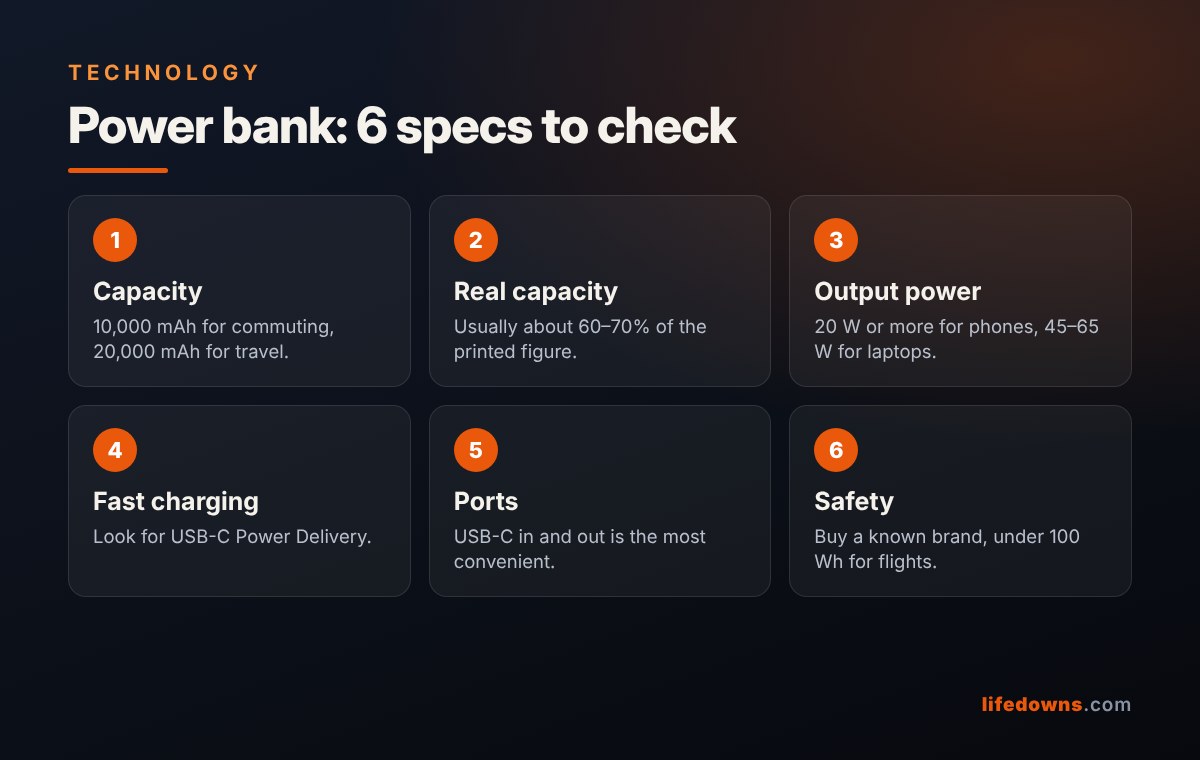
Spec 1: Capacity (mAh and Wh)
mAh tells you how much charge the pack holds. More capacity means more recharges, but also more weight. Besides mAh, look for the Wh (watt-hour) figure printed on the case. You can work it out: Wh = mAh x 3.7 / 1,000. For example, 20,000 mAh is about 74 Wh.
Spec 2: Real-world capacity
The printed mAh is the capacity of the cells inside. When charging a phone, some energy is lost to voltage conversion and heat, so the usable share is typically about 60–70%. A 10,000 mAh pack therefore fills a 5,000 mAh phone a little more than once, not twice.
Spec 3: Output power (W)
Wattage sets charging speed. For phones, choose 20 W or more. For laptops that charge over USB-C, you need 45–65 W depending on the model. Note that the headline figure is usually the maximum for a single port; with several devices plugged in, the power is shared.
Spec 4: Fast-charging standard
USB Power Delivery (PD) is the most widely supported standard, working with iPhones, many Android phones, tablets and laptops. Some phone brands use their own fast-charging systems; another brand’s pack will still charge them, but perhaps not at top speed.
Spec 5: Ports
Prefer a USB-C port that works for both input and output, so one cable does everything. An extra USB-A port is handy for older accessories. Check the input wattage too: a 20,000 mAh pack that only accepts 10 W takes many hours to refill.
Spec 6: Safety and airline rules
Buy from a clearly identified brand that lists full specifications and protections against overheating, overcurrent and short circuits. When flying, it must go in carry-on baggage, never checked. According to the FAA PackSafe guidance, the standard limit is 100 Wh per battery; 101–160 Wh needs airline approval. Airlines may be stricter, so check before you travel.
⚠️ Note: Stop using the pack at once if it swells, gets unusually hot, smells of burning, or has been dropped hard or soaked.
3. Tips to make a power bank last longer
- Avoid heat: do not leave it in a car, on a dashboard or in direct sun.
- Do not store it empty: if rarely used, top it up to about half every few months.
- Use a good cable: poor cables charge slowly and run hot.
- Avoid charging and discharging at the same time unless the maker says it is supported.
4. Summary: which power bank to choose
For most people, a 10,000 mAh pack with USB-C PD at 20 W or more from a reputable brand covers a full day. If you travel often or need to charge a laptop, step up to 20,000 mAh and 45 W or more, and check the Wh figure if you fly regularly.
More from our Technology section: Free Up Phone Storage: 6 Easy Steps to Clear Space When Your Phone Is Full and Software Updates on Your Phone and Computer: Why You Shouldn’t Skip Them and 6 Steps to Update Safely.
Frequently asked questions about power banks
How many charges does a 10,000 mAh power bank give
Usually about 1 to 1.5 charges for a phone with a 5,000 mAh battery, because only about 60–70% of the printed capacity is usable.
Can I take a 20,000 mAh power bank on a plane
Usually yes, since 20,000 mAh is about 74 Wh, under the 100 Wh limit. It must be in carry-on baggage, and you should check your airline’s own rules.
Does a power bank damage a phone battery
A certified pack is no harder on the battery than a wall charger. Avoid unbranded products and letting the phone overheat while charging.
When should I replace a power bank
Replace it when capacity drops noticeably or it shows swelling or unusual heat, and take the old one to an e-waste collection point.
What capacity do you carry? Tell us in the comments! 🔋⚡