
Fact-Check AI Answers: 6 Simple Steps to Avoid Mistakes
Knowing how to fact-check AI answers is a habit worth building for anyone who uses chatbots for study or work. AI tools write fluently and confidently, yet they sometimes produce wrong facts, invented numbers or citations that do not exist. This is commonly called AI “hallucination”.
This guide gives 6 simple checks to run before you put an answer into homework, a report or an important decision.
Contents: Fact-check AI answers
1. Why AI can get things wrong
A language model generates an answer by predicting which words fit next, based on the data it learned from. It does not look facts up like a dictionary unless it is connected to a search tool. That is why an answer can sound entirely reasonable and still be wrong. Read more about AI hallucination on Wikipedia.
The details most likely to be wrong are:
- Numbers, dates and names: easily confused or invented.
- Citations and links: can look real but not exist.
- Recent events: the model may not be up to date.
- Multi-step calculations: one intermediate slip spoils the result.
- Niche or local topics: little data means more guessing.
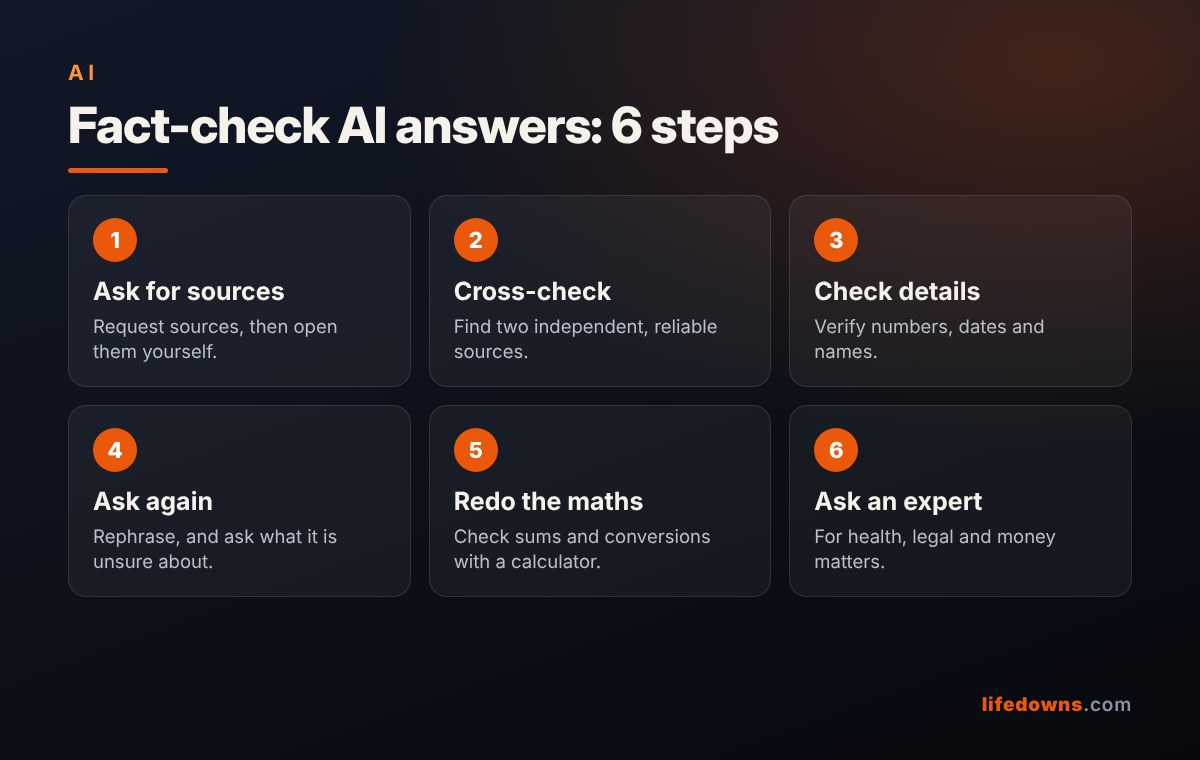
2. 6 steps to fact-check AI answers
Step 1: Ask for sources and open them
Ask the AI to give a source for each main claim. Then open every source yourself to confirm it exists and really says that. A source that does not load or is unrelated is a sign to dig deeper.
Step 2: Cross-check with two independent sources
Find the same information in at least two reliable sources that do not simply copy each other, such as government sites, professional bodies, textbooks or established news outlets.
Step 3: Verify numbers, dates and names
These small details are the most error-prone and also the easiest to check. Underline every figure, date, person and organisation in the answer and look each one up.
Step 4: Ask again in a different way
Rephrase the question or start a new conversation. If the two answers contradict each other, treat that as a warning. You can also ask: “Point out the parts of your answer you are not sure about.”
Step 5: Redo the maths
For sums, unit conversions and percentages, check with a calculator or spreadsheet. Asking the AI to show its working step by step also makes errors easier to spot.
Step 6: Ask an expert for high-stakes matters
For health, legal, financial and safety questions, treat the AI answer as a draft that helps you prepare questions. The decision should rest on advice from a qualified person.
💡 A prompt worth saving: “For every important claim, state the source. If you are unsure or have no source, say so plainly.”
3. How much checking each task needs
| Task | Level of checking |
|---|---|
| Brainstorming, drafts, headlines | A read-through is enough |
| Summarising a document you have | Compare the key points with the original |
| Facts for homework or reports | Cross-check sources, verify numbers |
| Health, legal, money | Check carefully and ask an expert |
4. Summary: make fact-checking a habit
AI is a fast and useful assistant, but you remain responsible for the final content. A few extra minutes to fact-check AI answers with the six steps above will prevent most avoidable mistakes.
More from our AI section: Write Emails with AI: 5 Easy Prompts You Can Use Today and How to Check the Result and Learn English with AI: 6 Simple Ways to Practice Speaking, Writing and Vocabulary in 20 Minutes a Day.
Frequently asked questions about fact-checking AI answers
Does AI know when it is wrong
Not reliably. AI can give a wrong answer in a very confident tone. Asking it to flag uncertainty helps, but does not replace checking.
Do I still need to check AI with web search
Yes. Search-connected tools are usually better on recent news, but they can still misread or mis-summarise a source. Open the original link.
Can I use another AI to check
It works as a first filter, but two tools can be wrong together. A reliable original source is the final reference.
What does AI get wrong most often
Specific numbers, dates, names, citations, links and very recent events.
Have you ever caught an AI being confidently wrong? Tell us in the comments! 🤖🔍