
Feynman Technique: 4 Simple Steps to Learn Deeply and 5 Mistakes to Avoid
You finish a chapter, nod along, and then cannot explain it when someone asks? The Feynman technique is built for exactly that moment: you only truly understand something when you can explain it in plain words.
This guide walks through the 4 steps of the Feynman technique, a worked example, and 5 mistakes that stop it from working.
Contents: Feynman Technique
1. What Is the Feynman Technique?
It is a study method named after Richard Feynman, the physicist who shared the 1965 Nobel Prize and was famous for explaining hard ideas in everyday language.
The core idea is short: try to teach what you just learned to someone who knows nothing about it. Wherever you hide behind jargon, you have not understood it yet.
2. The 4 Steps of the Feynman Technique
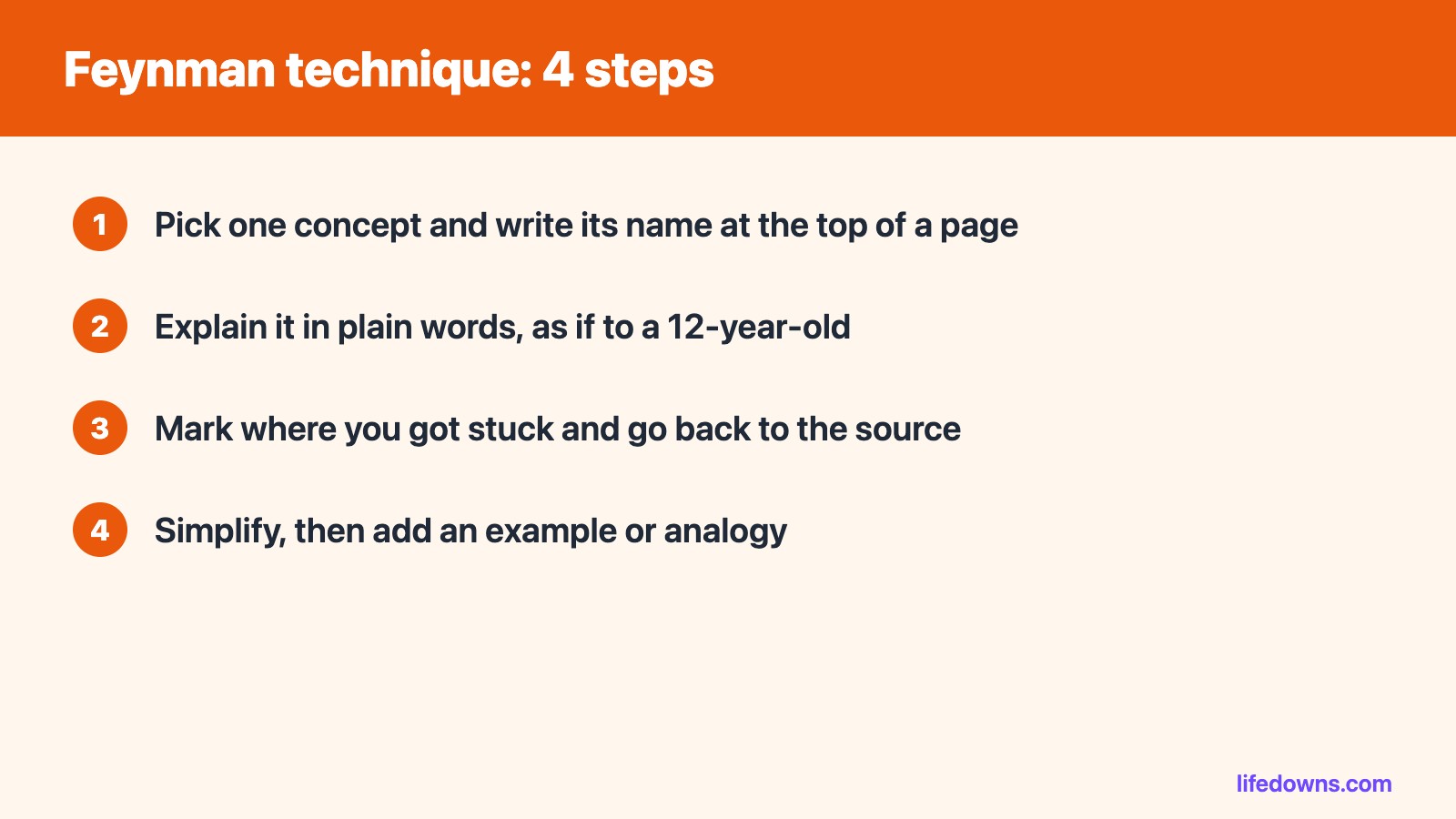
Step 1: Pick one concept
Write the name of the concept at the top of a blank page. Keep the scope small, for example “compound interest” instead of “personal finance”.
Step 2: Explain it in plain words
Close the book and write an explanation as if you were talking to a 12-year-old. Use short sentences and familiar words, and do not copy the textbook definition.
Step 3: Find where you got stuck
Mark the parts where you rambled, left a gap or borrowed a technical term. Those are your knowledge gaps. Go back to the source and reread only those parts.
Step 4: Simplify and add an example
Rewrite the explanation so it is shorter, and add an example or an analogy. Read it out loud. If it still sounds awkward, repeat step 3.
3. Example: Explaining Compound Interest
| Draft | Explanation | Comment |
|---|---|---|
| Draft 1 | Compound interest is interest calculated on the principal and on accumulated interest. | Still sounds like the textbook |
| Draft 2 | You deposit 100 and have 110 at the end of the year. Next year, interest is paid on 110, not 100. | Clearer thanks to numbers |
| Draft 3 | It is like a snowball rolling downhill: the bigger it gets, the more snow it picks up on each turn. | Has an image, easy to remember |
💡 Tip: If you have nobody to teach, record yourself for 2 minutes on your phone and listen back. The places where you hesitate are the places to study again.
4. 5 Common Mistakes With the Feynman Technique
- Choosing a topic that is too broad: one page cannot hold a whole subject, so break it down.
- Writing with the book open: that is copying, not testing your memory.
- Keeping the jargon: every technical term should be replaced by a sentence that explains it.
- Skipping step 3: without going back to the source, the gaps stay where they are.
- Doing it only once: a good explanation usually takes two or three rewrites.
5. Summary: When Should You Use It?
The Feynman technique works best for material you need to understand, such as maths, science, economics and programming. For things you need to memorise, like vocabulary, combine it with other review methods.
With one sheet of paper and 15 minutes per concept, you will know how much you really understand instead of only feeling that you do.
Read more: Cornell Note-Taking Method: 5 Easy Steps to Better Notes You Can Actually Review and The Pomodoro Technique: 5 Simple Steps to Study and Work with Better Focus, 25 Minutes at a Time.
Frequently Asked Questions About the Feynman Technique
How long does the Feynman technique take per concept?
Usually about 15–30 minutes for a small concept, depending on difficulty and how often you need to go back to the source.
Do I need a real listener?
No. You can write it down, record yourself or speak out loud. A real listener is better because they ask follow-up questions.
Does it work for learning a language?
It works for grammar, for example explaining when to use a tense. For vocabulary, spaced repetition is more effective.
How is it different from summarising?
A summary shortens existing content. The Feynman technique makes you restate it in your own words and actively look for what you do not understand.
Which concept will you try explaining first? Tell us in the comments! 🧠✍️