
Air Conditioner Energy Saving: The Best Temperature and 6 Easy Habits to Cut Your Bill
Air conditioner energy saving is on almost every household’s mind when the hot season arrives, because the air conditioner is usually the biggest power user at home. The good news is that you do not have to put up with the heat to bring the bill down.
This guide explains what temperature to set and suggests 6 easy habits for air conditioner energy saving that keep you cool and that you can start tonight.
Contents: air conditioner energy saving
1. Why does an air conditioner use so much power?
An air conditioner does not “make” cold air; it moves heat from inside the room to the outside. The bigger the gap between the temperature you set and the outdoor temperature, the longer and harder the compressor has to work.
On top of that, open doors, direct sunlight and dusty filters all make the unit work harder to reach the same level of comfort.
2. What temperature should you set?
A setting of 26–28°C (about 78–82°F) is widely recommended because it is comfortable without overworking the unit. A lower setting does not cool the room faster; it only makes the unit run longer. As a rule, every degree you go up reduces the energy used.
| Situation | Suggested setting | Notes |
|---|---|---|
| Daytime, normal activity | 26–27°C | Combine with a fan on low |
| Sleeping | 27–28°C | Use sleep mode or a timer |
| Young children or older adults | 27–28°C | Avoid air blowing straight at them |
| Just came in from the sun | 26°C | No need to drop to 16–18°C |
Note: These are general suggestions; comfort also depends on humidity, the number of people in the room and personal preference.
3. 6 easy habits for air conditioner energy saving
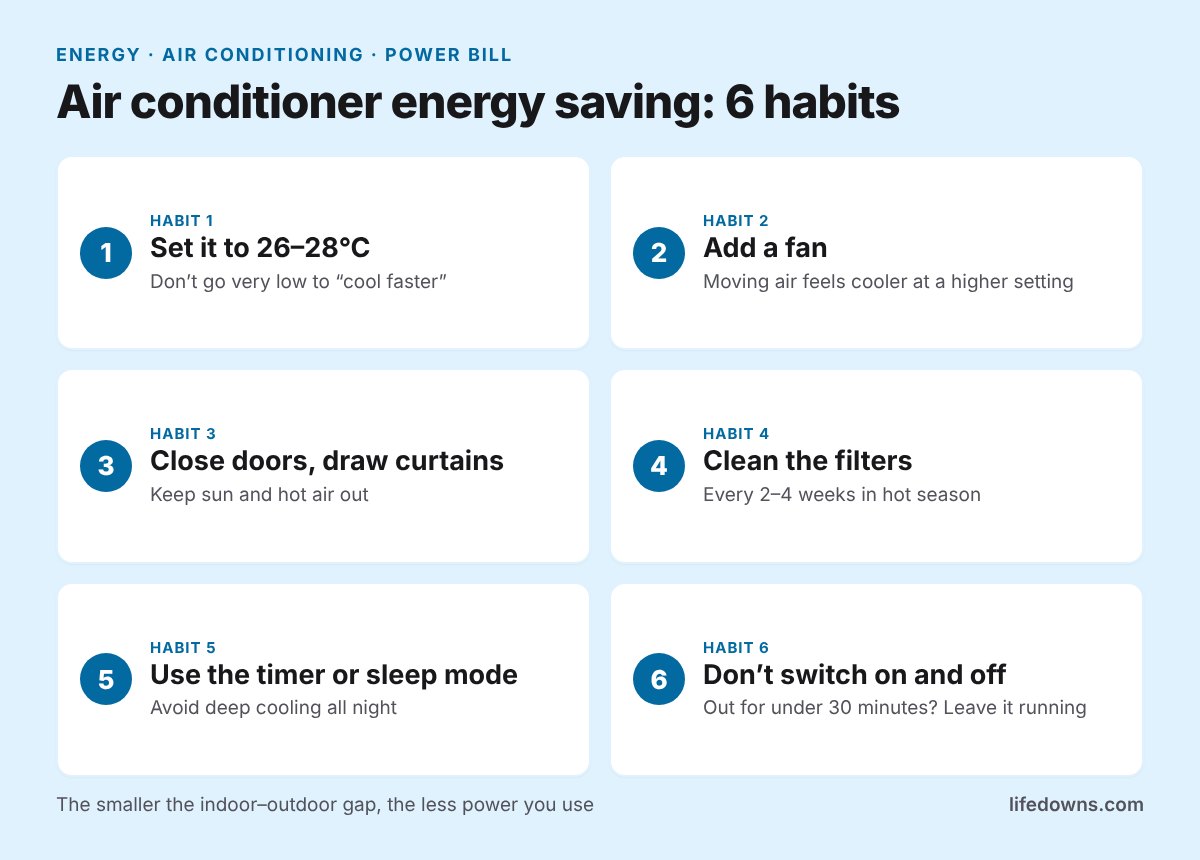
Habit 1: Set 26–28°C and keep it steady
Choose a comfortable temperature and leave it alone. Dropping it very low and then raising it again makes the compressor run flat out over and over, and sudden temperature swings are tiring for your body too.
Habit 2: Add a fan
A fan does not lower the room temperature, but moving air makes you feel cooler, so you can set the air conditioner 1–2 degrees higher. A fan uses far less electricity than an air conditioner.
💡 Quick tip: Run the fan on low and point it upward or let it oscillate so cool air spreads evenly around the room.
Habit 3: Close doors and draw the curtains
Gaps around doors and sunlight through glass are the two biggest sources of heat coming in. Close the door, seal gaps and draw curtains on sun-facing windows, especially west-facing ones in the afternoon.
Habit 4: Clean the filters regularly
A dusty filter blocks airflow, so the unit cools poorly and wastes energy. ENERGY STAR advises checking the filter every month during heavy-use seasons. On a wall-mounted unit you can remove the filters yourself, rinse them with water and let them dry every 2–4 weeks.
💡 Quick tip: Once a year, before the hot season, have a technician clean the indoor and outdoor units and check the refrigerant.
Habit 5: Use the timer and sleep mode
At night the outdoor temperature falls and your body needs less cooling. Sleep mode raises the temperature gradually after a few hours; you can also set the timer to switch off toward morning and move to a fan.
Habit 6: Do not switch on and off constantly
Each time it restarts, the unit has to cool a room that has warmed up again. If you are only stepping out briefly, under about 30 minutes, leave it running. If you will be away longer, switch it off.
4. Common mistakes
- Dropping to 16–18°C to “cool faster”: the cooling speed does not change, only the power use.
- Running heat sources in the room: irons, cookers and dryers warm the room up.
- Choosing the wrong capacity: a unit too small for the room has to run non-stop.
- Blocking the outdoor unit: it needs airflow and, if possible, shade.
- Forgetting to switch off when you leave for hours: a timer is the simplest fix.
5. Summary: air conditioner energy saving without giving up comfort
Air conditioner energy saving needs no extra investment: set 26–28°C, add a fan, keep the room closed, wash the filters, use the timer and avoid constant on-off cycles. When it is time to buy a new unit, look for an inverter model with a high energy rating and a capacity that matches your room size.
More in Energy: Standby Power: 6 Simple Ways to Cut “Phantom” Electricity from Devices You Aren’t Using and Fridge Energy Saving: 7 Simple Ways to Cut Your Electricity Bill While Keeping Food Fresh.
Frequently asked questions about air conditioner energy saving
What is the most efficient temperature for an air conditioner?
A setting of 26–28°C is widely recommended. The closer the setting is to the outdoor temperature, the less power the unit uses.
Does dry mode use less electricity?
Dry mode is useful on humid days that are not very hot. In strong heat, cool mode at 26–28°C is still the better choice.
Is it expensive to run the air conditioner all night?
It does add to the bill, but you can cut it noticeably by setting 27–28°C, using sleep mode, adding a fan and setting a timer to turn off toward morning.
Do inverter units really save energy?
Inverter units adjust compressor speed instead of switching on and off, so they usually save more when used for many hours a day. If you run it for only 1–2 hours, the difference is smaller.
What temperature do you set at home? Share your best tips for air conditioner energy saving in the comments! ❄️💡