
Hybrid Car Guide: 3 Common Types and 6 Essential Things to Know Before You Buy
A hybrid car uses both a petrol engine and an electric motor. The two power sources take turns or work together to move the car, so it burns less fuel than a petrol-only car of the same size.
If you are weighing up petrol, electric and a hybrid car, this guide explains how hybrids work, the 3 common types, the pros and cons, and 6 essential things to know before you spend your money.
Contents: hybrid car guide
1. What is a hybrid car and how does it work?
According to the US Department of Energy’s Alternative Fuels Data Center, a hybrid is powered by an internal combustion engine together with one or more electric motors that draw energy from a battery. The battery is charged by regenerative braking, which recovers energy as the car slows down, and by the engine itself.
At low speed or when pulling away, the electric motor does most of the work. When you need strong acceleration or are cruising on the highway, the petrol engine joins in. The system switches automatically, so the driver does not have to do anything extra.
2. The 3 common types of hybrid car
| Type | Plugs in | Electric-only driving | Best for |
|---|---|---|---|
| Mild hybrid (MHEV) | No | No, the motor only assists | Drivers who want a small saving at near-petrol price |
| Full hybrid (HEV) | No | Short distances at low speed | City drivers with no place to charge |
| Plug-in hybrid (PHEV) | Yes | Tens of kilometres per charge | Drivers who can charge at home or work |
Note: Electric range and fuel savings vary by model; check the figures published by the manufacturer.
Mild hybrid (MHEV)
A small motor and a small battery only assist the petrol engine when starting and accelerating; the car cannot drive on electricity alone. It saves the least of the three types, but its price is also the closest to a petrol car.
Full hybrid (HEV)
This is the most familiar type. The car does not need, and cannot use, a plug; the battery charges itself as you drive. You fill up and drive as usual, while electricity takes over at the moments when a petrol engine is least efficient.
Plug-in hybrid (PHEV)
It has a bigger battery and a charging port. Fully charged, it can drive on electricity alone far enough for many people’s daily trips, then carries on like a normal hybrid. If you do not charge it regularly, you are simply carrying a heavy battery around.
💡 Quick tip: No fixed place to charge? Choose a full hybrid (HEV) rather than a PHEV.
3. Pros and cons of a hybrid car
Pros
- Lower fuel use: most noticeable in stop-and-go city traffic.
- No range anxiety: you still fill up with petrol as usual.
- Quiet and smooth at low speed: the electric motor gives instant pull.
- Fewer emissions: the engine rests when the car is stopped or moving slowly.
Cons
- Higher purchase price: usually more than the petrol version of the same model.
- A more complex system: extra battery, motor and power electronics.
- Smaller benefit on the highway: at steady high speed the engine runs almost all the time.
- The battery ages: factor in replacement cost after the warranty ends.
4. 6 essential things to know before buying a hybrid car
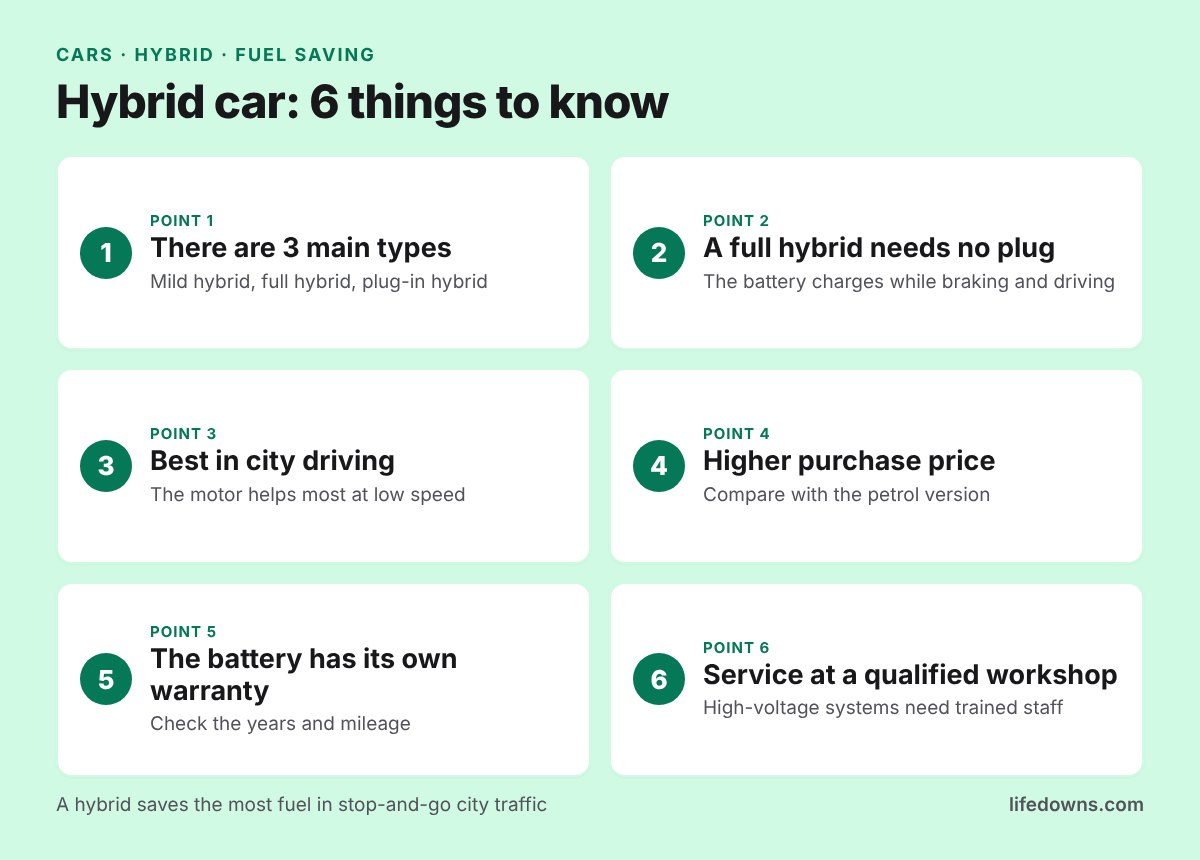
Point 1: Identify the exact hybrid type
The word “hybrid” in an advert can mean MHEV, HEV or PHEV, and the savings differ widely. Ask clearly whether the car can drive on electricity alone and whether it has a charging port.
Point 2: Check whether you drive mostly in the city or on highways
If most of your distance is urban and congested, a hybrid performs at its best. If you mainly drive on highways, the gap to a petrol car will be smaller.
Point 3: Work out the payback time
Take the price difference against the petrol version and divide it by the fuel money you save each year at the distance you really drive. The more you drive, the faster it pays back.
💡 Quick tip: Use the manufacturer’s combined fuel consumption figures to compare, and remember that real-world numbers are usually a little higher.
Point 4: Read the battery warranty carefully
Hybrid batteries usually have their own warranty, set in years and distance. Ask the dealer about the term, the conditions and an indicative replacement cost.
Point 5: Check where you can service it
Most service items are the same as on a petrol car, but the high-voltage system needs trained technicians and special equipment. See whether there is a qualified workshop near where you live.
Point 6: Test-drive in your real conditions
The feel of regenerative braking and of the engine switching on and off can be unfamiliar at first. Test-drive both in town and on an open road to see whether you are comfortable with it.
5. Summary: who is a hybrid car best for?
A hybrid car is a sensible middle ground for people who want to cut fuel costs but are not ready to go fully electric, especially if they drive mostly in the city and have nowhere to charge. Before buying, identify the hybrid type, work out the payback time for your own mileage and read the battery warranty carefully.
More in Cars: Motorbike Oil Change: How Often to Do It and 6 Essential Tips for Choosing the Best Oil and Long Motorbike Trip Checklist: 7 Essential Things to Prepare Before You Ride.
Frequently asked questions about owning a hybrid car
Does a hybrid car need to be plugged in?
Full hybrids (HEV) and mild hybrids do not need a plug; the battery charges during braking and while the engine runs. Only plug-in hybrids (PHEV) need charging to make full use of their electric range.
How much fuel does a hybrid car save?
It depends on the model and how you drive, and it is most noticeable in city traffic. Compare the published consumption of the hybrid and petrol versions of the same model.
How long does a hybrid battery last?
The battery is designed to last many years and usually has its own warranty. Actual life depends on use and climate, so check the manufacturer’s warranty terms.
Can a hybrid car drive through flooded roads?
Hybrids are sealed to the manufacturer’s standards, but as with any car you should not attempt deep water. Follow the wading limit stated in the owner’s manual.
Are you deciding between a hybrid and an electric car? Share your reasons in the comments so other readers can learn from them! 🚗🔋