
Mind Map: 5 Simple Steps to Draw One and 6 Mistakes to Avoid
A mind map is a visual way of taking notes: the main topic sits in the middle of the page, big ideas radiate out as branches, and each branch splits into smaller ideas. Instead of a dense page of text, you get a picture that shows how the ideas connect.
This guide walks through 5 steps to draw one with just paper and a pen, points out 6 mistakes beginners often make and suggests when this style of note-taking works best.
Contents: Mind map
1. What a mind map is and what it is good for
The technique was popularised by British author Tony Buzan from the 1970s. The core idea is to use keywords, branches, colour and small drawings to organise information in a radial structure instead of top-to-bottom lines. You can read more about its background in the Wikipedia article on the technique.
It is especially useful for three jobs:
- Summarising a chapter or lecture: all the main points on one page you can take in at a glance.
- Generating ideas: planning an essay, a presentation or a small project.
- Revising before an exam: cover the map and redraw it from memory to see what is missing.
2. 5 steps to draw a mind map
Step 1: Write the topic in the centre
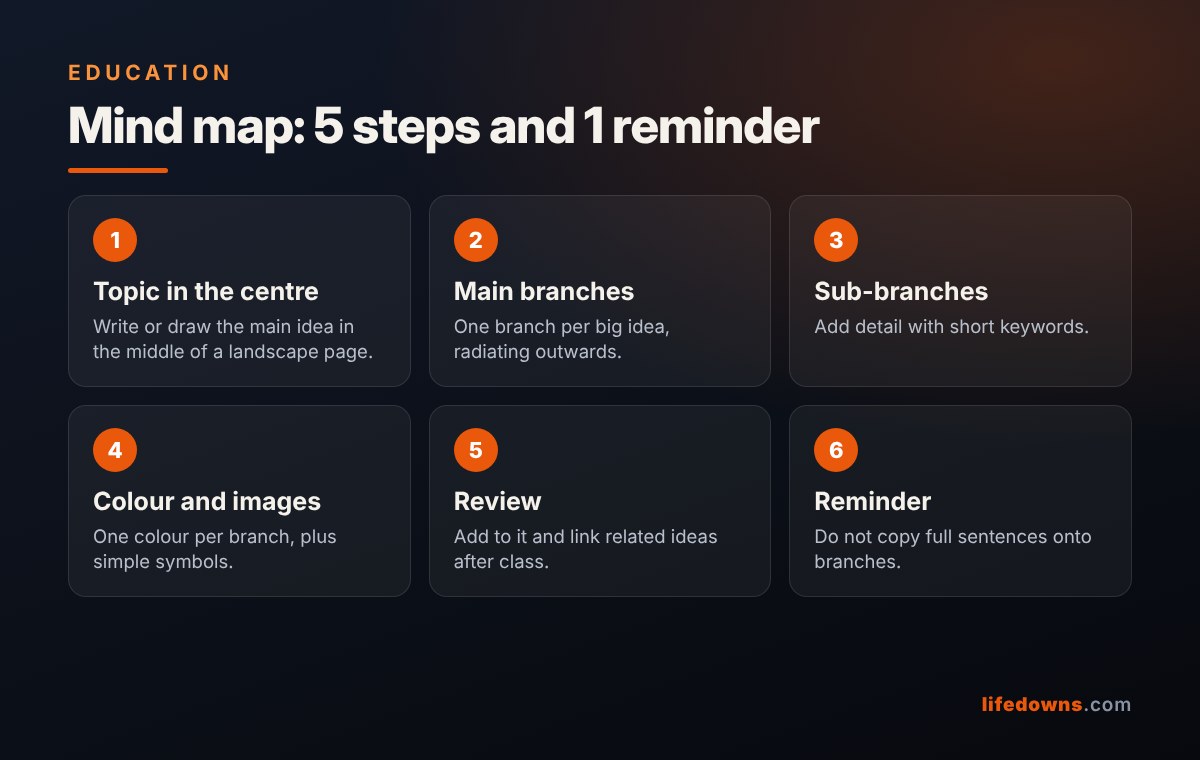
Turn the page to landscape so the branches have room. Write the topic in the middle and circle it, or add a simple drawing. For example: “Photosynthesis”, “World War II”, “My English study plan”.
Step 2: Draw the main branches
From the centre, draw three to seven thick branches, one for each main idea or section. Write a single keyword on each branch. If there are too many big ideas, merge the ones that belong together.
Step 3: Add sub-branches with keywords
From each main branch, draw thinner branches for details, examples, formulas or dates. Keep each one to one to three words. Being forced to shorten is exactly when understanding happens.
Step 4: Use colour and images
Give each main branch its own colour so your eye can separate them quickly. Add simple symbols such as arrows, stars or tiny sketches for key points. It does not have to be pretty, only recognisable to you.
Step 5: Review and add to it
After class, spend a few minutes looking over the whole map. Link related ideas on different branches with arrows and fill in gaps. A few days later, try redrawing the map without looking at the original.
💡 Quick tip: For your first attempt, pick a topic you already know well, such as “my typical day”. Move on to difficult material once the method feels natural.
3. 6 mind map mistakes to avoid
- Copying full sentences onto branches: the map turns into ordinary notes bent into curves.
- Too many main branches: more than seven is hard to read, so merge them.
- Using a single colour: you lose the visual separation.
- Over-decorating: thirty minutes of colouring without understanding misses the point.
- Drawing it once and filing it away: most of the value comes from reviewing and redrawing.
- Using it for everything: multi-step calculations or long lists that must be learned in order often suit other formats better.
4. Paper or an app
| Method | Strengths | Limits |
|---|---|---|
| Pen and paper | Fast, distraction-free, writing by hand helps recall | Hard to edit or share |
| App | Easy to edit, expand and share with a group | Tempting to fiddle with styling, needs a device |
If the goal is to learn and remember, pen and paper is usually enough. If you need to collaborate or keep the map for a long time, an app is more practical.
5. Summary: how to start with a mind map
Pick one lesson from today, take a landscape sheet of paper and draw one in ten minutes using the five steps above. Do not aim for perfection. After a few attempts you will find the style that suits you.
More from our Education section: Feynman Technique: 4 Simple Steps to Learn Deeply and 5 Mistakes to Avoid and Cornell Note-Taking Method: 5 Easy Steps to Better Notes You Can Actually Review.
Frequently asked questions about mind maps
Does a mind map need to look good
No. It only needs to be clear to you. Legible words, distinct branches and a few colours are enough.
How many main branches should a mind map have
Three to seven main branches are easiest to read. If you have more, merge related ideas or split the topic into two maps.
Do mind maps work for maths
They work well for organising formulas, problem types and links between chapters. For practising solutions you still need to work through problems.
Should I draw a mind map during or after a lecture
Beginners should take quick notes in class and draw the map afterwards as a summary. With practice you can draw it live.
Which subject do you use a mind map for most? Tell us in the comments! 🧠✏️