
Cornell Note-Taking Method: 5 Easy Steps to Better Notes You Can Actually Review
The Cornell note-taking method is a way of taking notes that splits a page into three parts: a cue column, a notes column and a summary box. Instead of copying every word, you write down the main ideas, turn them into questions and sum them up in your own words.
If you have ever opened your notebook before an exam and could not make sense of what you wrote, this guide is for you. Below are 5 easy steps to use the Cornell note-taking method in any subject, with a page layout and the most common mistakes.
Contents: Cornell note-taking method
1. What is the Cornell note-taking method?
The method was introduced by Professor Walter Pauk at Cornell University in the 1950s and is still taught to students today. You can read the original introduction at the Cornell Learning Strategies Center.
What makes it different is that the page is not only a place to store information but also a self-testing tool. The left column holds the questions and the right column holds the answers, so you can cover one side and quiz yourself.
2. How to divide the page into three parts
All you need is a sheet of paper or a normal notebook page, a ruler and a pen. Draw the page like this:
- Cue column (left): about one third of the page, for keywords and questions.
- Notes column (right): about two thirds of the page, for the lesson content.
- Summary box (bottom): about 5 cm high, for a 2–3 sentence wrap-up.
💡 Quick tip: Rule 10–20 pages at the weekend, or print a ready-made template, so you only have to write in class.
3. 5 steps to use the Cornell note-taking method
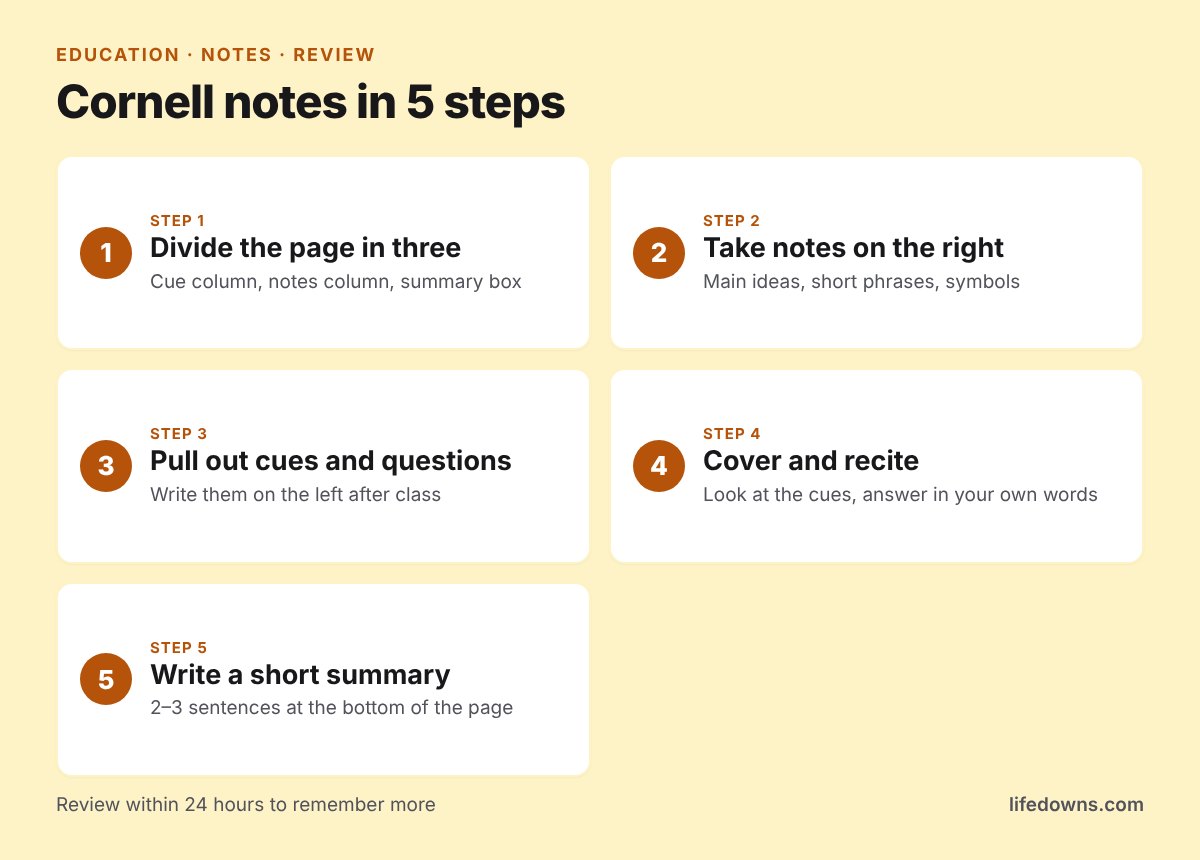
Step 1: Prepare the page
Write the date, subject and topic at the top. This small habit helps you find the right page quickly at revision time and see which chapter it belongs to.
Step 2: Take notes in the right column
During the lesson, write only in the notes column. Use short phrases, bullet points, symbols and abbreviations you know. Do not try to copy word for word; capture main ideas, examples, formulas and anything the teacher stresses.
- Leave a blank line between ideas so you can add to them later.
- Mark anything unclear with a question mark and ask about it.
- Draw a small diagram when it is faster than writing.
Step 3: Pull out cues and questions
Right after class, or by the end of the day at the latest, reread the notes column and fill in the cue column: keywords, key concepts or, better still, a question that the notes beside it answer. For example: “What does photosynthesis need?”
Step 4: Cover the notes and recite
Cover the notes column with a sheet of paper, look only at the cues, then say or write the answer in your own words. Uncover and check. This is the most important step, because recalling information helps you remember far more than rereading it.
💡 Quick tip: Put a star next to any cue you get wrong. Next time, focus on the stars.
Step 5: Write a summary at the bottom
Write 2–3 sentences that sum up the whole page. If you cannot do it, you have not really understood the lesson yet and should look again. The summary is also the first thing you skim when revising.
4. How to review Cornell notes effectively
A page of notes only pays off when you come back to it. Here is a simple review schedule many students use:
| When | What to do | Time |
|---|---|---|
| Same day | Fill in cues, write the summary | 10 minutes |
| After 1 day | Cover the notes and recite | 5–10 minutes |
| End of the week | Revisit the starred cues | 10–15 minutes |
| Before the exam | Read summaries, test yourself on everything | Depends on pages |
Note: This is a general guide; adjust it to your timetable and the difficulty of each subject.
Common mistakes
- Writing too much: a notes column packed with text is hard to reread.
- Leaving the cue column empty: without questions you cannot test yourself.
- Summarising days later: by then you have forgotten most of the context.
- Rereading without reciting: feeling familiar is not the same as remembering.
5. Summary: who is the Cornell note-taking method for?
The Cornell note-taking method suits school and university students as well as working adults who need to capture a course or a meeting. It works especially well for concept-heavy subjects such as history, biology, law and economics. For problem-based subjects such as maths, use the left column for the problem type and the right column for a worked example.
Try it with one subject for one week. With just 10 minutes a day for steps 3 to 5, exam revision becomes noticeably lighter.
More in Education: The Pomodoro Technique: 5 Simple Steps to Study and Work with Better Focus, 25 Minutes at a Time and Spaced Repetition Made Simple: 5 Easy Steps to Learn Vocabulary That Actually Sticks.
Frequently asked questions about the Cornell note-taking method
Can I use the Cornell note-taking method on a laptop or tablet?
Yes. You can build a two-column table in a notes app or use a ready-made Cornell template. Handwriting, however, often helps you select ideas because you cannot copy everything word for word.
How long should each page of Cornell notes be?
Use one page for one topic or one part of a lesson. For a long lesson, use several pages and write a separate summary on each.
When should I fill in the cue column?
Ideally right after class or within 24 hours, while you still remember the context of the lesson.
How are Cornell notes different from a mind map?
Cornell notes follow the order of the lesson and have self-testing built in. A mind map is stronger for seeing the big picture and linking ideas. You can combine both.
Have you tried the Cornell note-taking method? Leave a comment to share how you take notes, and save this post for your next class! ✍️📒