
Car Tire Pressure: How to Check It and 6 Essential Things to Remember
Car tire pressure is easy to forget because a slightly soft tire is almost impossible to spot by eye. Yet the four tires are the only parts of the car touching the road, and they directly affect braking distance, grip, fuel use and tire life.
This guide explains where to find the correct figure, how to measure properly and 6 essential things to remember about car tire pressure.
Contents: Car tire pressure
1. What is the right car tire pressure
There is no single number for every car. The right figure is the one the vehicle maker recommends, printed on a placard on the driver’s door jamb or in the owner’s manual. Many passenger cars fall in the range of 2.1–2.5 bar (30–36 psi), and the figure may differ between front and rear or for a full load.
According to tire guidance from NHTSA, the US road safety agency, you should check at least once a month when the tires are cold.
| Unit | Approximate conversion |
|---|---|
| 1 bar | 14.5 psi |
| 1 bar | 100 kPa |
| 32 psi | About 2.2 bar |
| 35 psi | About 2.4 bar |
2. How to check car tire pressure
- Get a gauge: a pencil or digital gauge both work; keep one in the car.
- Remove the valve cap: put it somewhere it will not get lost.
- Press the gauge straight onto the valve: push firmly until the hissing stops, then read the number.
- Compare with the placard: add air if low; release some by pressing the valve pin gently if high.
- Refit the cap: repeat for all four tires and the spare.
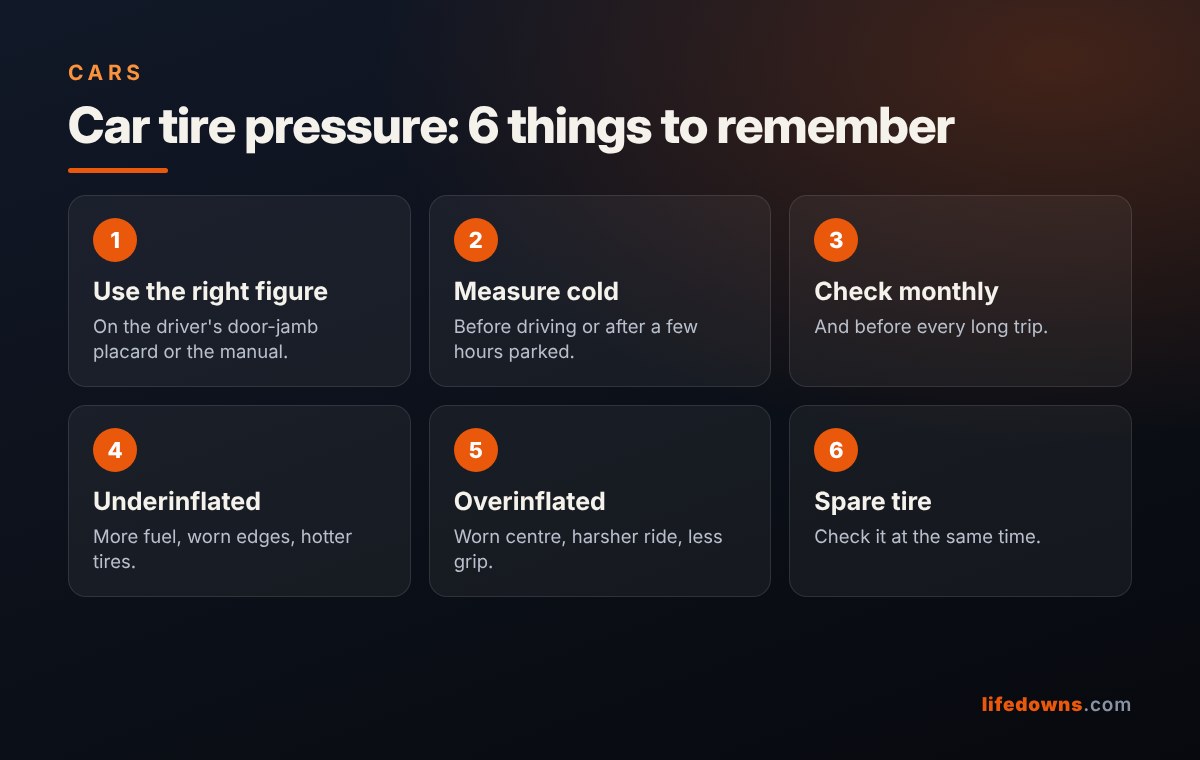
3. 6 things to remember about car tire pressure
1: Use the right figure
The number moulded into the tire sidewall is the maximum the tire can take, not the pressure to run. Always use the figure on the door-jamb placard or in the manual.
2: Measure when the tires are cold
Tires warm up as you drive and the pressure rises, so a reading after a long drive is higher than the true cold value. Measure in the morning before setting off, or after the car has been parked for about three hours.
3: Check monthly and before long trips
Tires lose air slowly even without a puncture, and pressure also drops when the weather turns cold. A monthly reminder is enough.
4: Underinflation is more dangerous than it looks
Soft tires raise rolling resistance, so the car uses more fuel, the outer edges wear quickly and the steering feels heavy. The tire also flexes more and heats up at speed, raising the risk of a blowout.
5: Overinflation is not good either
Too much air shrinks the contact patch, makes the ride harsher, wears the centre of the tread faster and reduces grip, especially on wet roads.
6: Do not forget the spare and the sensors
A spare that sits untouched for months is often flat just when you need it. And the tire pressure monitoring system (TPMS) light usually comes on only when a tire is significantly low, so it does not replace regular manual checks.
⚠️ Note: If one tire keeps dropping below the others every few days, it probably has a nail or a leaking valve. Have it inspected soon.
4. Signs your tire pressure is wrong
| Sign | Likely cause |
|---|---|
| Heavy wear on both edges | Long-term underinflation |
| Heavy wear in the centre | Overinflation |
| Heavy steering, sluggish car | Underinflation |
| Harsh, bouncy ride on rough roads | Overinflation |
| Car pulls to one side | One tire lower than the others |
5. Summary: five minutes a month for car tire pressure
A small gauge and five minutes a month are enough to keep car tire pressure where it should be. In return you get a smoother ride, lower fuel use, longer-lasting tires and, above all, more safety.
More from our Cars section: Toyota Century SUV: Specs, Interior, Price and 7 Essential Facts and 7-Seater Family Car: 9 Best Picks by Segment and Price in Vietnam (2026).
Frequently asked questions about car tire pressure
Where do I find the recommended car tire pressure
On the placard on the driver’s door jamb, sometimes inside the fuel filler flap, and in the owner’s manual.
How often should I check tire pressure
At least once a month and before every long trip, measured when the tires are cold.
Should I add more air when carrying a heavy load
Only up to the full-load figure the manufacturer gives on the placard or in the manual. Do not go beyond it.
Is nitrogen worth it
Not necessary for everyday driving. Ordinary air is fine as long as you check the pressure regularly.
When did you last check your tire pressure? Tell us in the comments! 🚗🔧