
Motorbike Oil Change: How Often to Do It and 6 Essential Tips for Choosing the Best Oil
A motorbike oil change done on time is the cheapest piece of maintenance you can do, yet it has the biggest effect on engine life. Old, dirty or low oil makes the engine run hotter, louder and thirstier, and wears it out faster.
So how often should a motorbike oil change happen, and which bottle should you pick from the dozens on the shelf? This guide sums it up in 6 essential tips that work for both manual bikes and scooters.
Contents: motorbike oil change
1. What does oil do in the engine?
Engine oil forms a thin film between moving metal parts to reduce friction. Besides lubricating, it carries heat away, picks up dirt and protects against rust.
Over time, heat and contaminants break the oil down, so it becomes too thin or too thick and stops protecting well. On manual and clutch bikes, the same oil also lubricates the clutch and gearbox, which makes the right type even more important.
2. How often should you do a motorbike oil change?
The most accurate answer is in your owner’s manual, because every maker and model has its own interval. In practice, many riders and mechanics use these rough guidelines:
| Situation | Typical interval | Notes |
|---|---|---|
| New bike, first change | About 500–1,000 km | Follow the first-service schedule |
| Mineral oil | About 1,500–2,000 km | Common for daily city riding |
| Semi-synthetic or synthetic | About 2,000–4,000 km | Check the bottle and the manual |
| Bike that is rarely ridden | Every 3–6 months | Even if the mileage is low |
Note: These figures are general guidelines only. Always follow the recommendation in your own owner’s manual first.
💡 Quick tip: Save the mileage and date of each oil change on your phone, or ask the mechanic for a reminder sticker, so you never have to guess.
3. 6 essential tips for a motorbike oil change
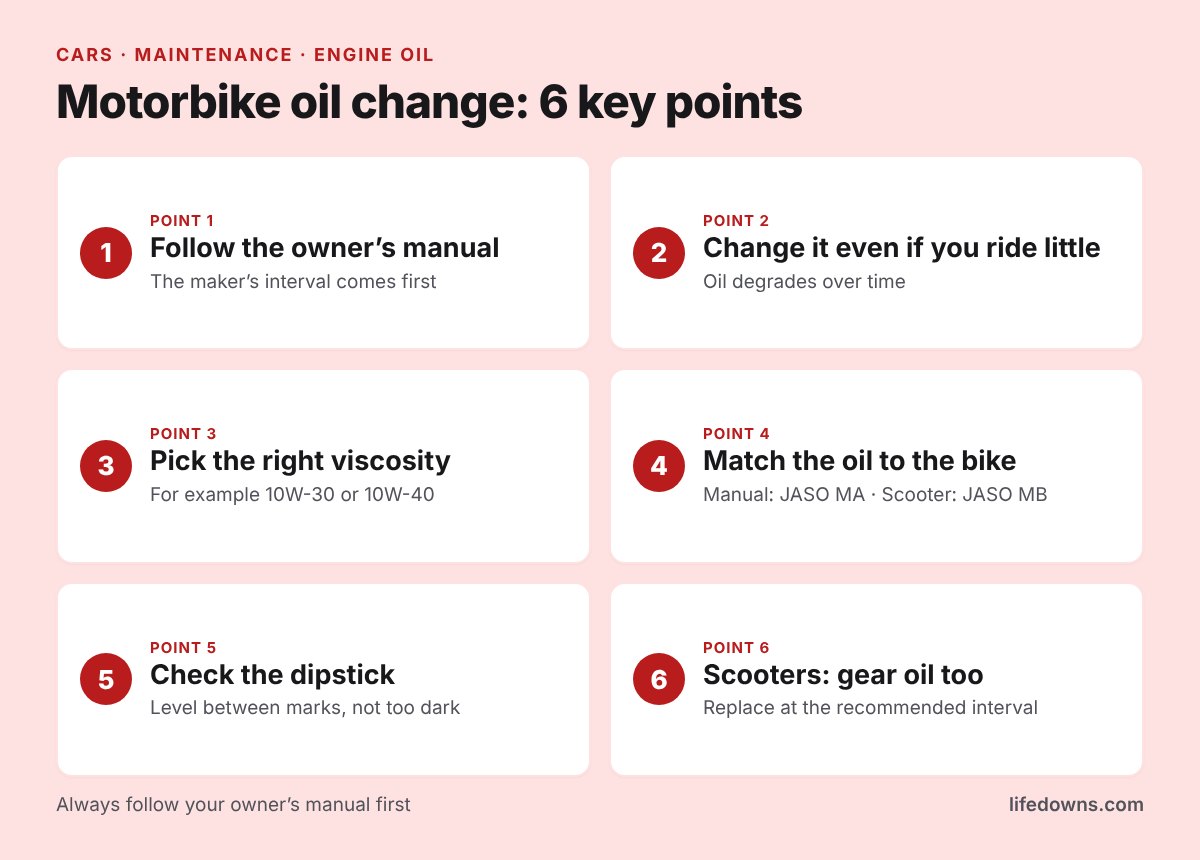
Tip 1: Follow the owner’s manual
The manual states the interval, oil capacity, viscosity and recommended standard. If you have lost it, ask an authorised dealer or look it up on the maker’s website for your exact model year.
Tip 2: Change it even if you ride little
Oil degrades with time, not just distance. A bike used only for short trips, where the engine never fully warms up, is even more likely to collect moisture in the oil.
Tip 3: Pick the right viscosity
Codes such as 10W-30 or 10W-40 describe how thin the oil is when cold and when hot. Use the viscosity listed in your manual. Oil that is thicker or thinner than the engine was designed for is not better.
Tip 4: Match the oil to the bike type
Motorbike oil bottles usually show a JASO rating. Manual and clutch bikes use a wet clutch, so they need JASO MA or MA2 oil to stop the clutch from slipping. Scooters generally use JASO MB oil. Car oil is not a good choice for a motorbike.
💡 Quick tip: Buy from a trusted shop and check the seal and label to avoid counterfeit oil.
Tip 5: Check the dipstick yourself
Stand the bike upright on level ground, switch off the engine for a few minutes, pull out the dipstick, wipe it clean and dip it again. The level should sit between the two marks. If the oil is thick and black, gritty or low, change it or have the bike checked.
Tip 6: Scooters need gear oil too
Scooters have separate gear oil in the final drive. It also needs replacing at the interval the maker recommends, usually once every few engine oil changes.
4. Signs you need an oil change sooner
- The engine sounds louder or rougher than usual.
- The bike feels sluggish and uses more fuel.
- Gear changes feel heavy or notchy on a manual bike.
- The engine gets hot quickly even on short rides.
- Oil on the dipstick is thick and black or has metal flecks.
- You have just ridden through deep flood water.
5. Summary: a timely motorbike oil change keeps the engine healthy
A motorbike oil change is not complicated: follow the manual, change on time even when you ride little, and choose the right viscosity and type for a manual bike or scooter. The small cost of each change is far lower than the cost of an engine repair.
More in Cars: Long Motorbike Trip Checklist: 7 Essential Things to Prepare Before You Ride and Riding a Motorbike in the Rain: 7 Essential Safety Tips Before, During and After a Downpour.
Frequently asked questions about a motorbike oil change
How long does a motorbike oil change take?
Usually about 10–15 minutes at a workshop. It is best done while the engine is slightly warm so the old oil drains fully.
Can I just top up instead of changing the oil?
Topping up is only a temporary fix when the level drops. The old oil is still dirty and worn, so you still need to drain and replace it when it is due.
Is synthetic oil worth the extra money?
Synthetic oil generally handles heat better and keeps its viscosity longer, which suits bikes that are ridden a lot or over long distances. For light city use, mineral oil changed on time is enough.
Do I need an oil change after riding through a flood?
If water reached the exhaust or air filter, have the bike checked and the oil changed, because water makes the oil milky and stops it lubricating.
How many kilometres do you ride between oil changes? Share your experience in the comments and save this post for your next service! 🛢️🛵