
Family Board Games: 7 Easy Picks for a Fun Weekend Night at Home
Family board games are a simple way to bring the whole household together without a TV or a phone. All you need is one game, a table and about 30 minutes for a weekend night full of laughter.
If you are not sure where to start, this guide suggests 7 easy family board games with simple rules that work for young children and grandparents alike, plus tips on choosing a game and hosting a fun game night.
Contents: family board games
1. Why play family board games?
A board game makes people look at each other, talk and wait for their turn. Those things are hard to get when everyone is holding their own screen.
- Connection: the whole family shares one activity.
- Children learn a lot: counting, mental maths, taking turns, winning and losing.
- Low cost: one game lasts for years.
- Less screen time: for adults as well as children.
2. How to choose family board games that fit
A game that is great with friends may not suit a family with small children. Before you buy, check the three details usually printed on the box: number of players, age and playing time.
- Rules you can explain in 5 minutes: the shorter the rules, the faster everyone joins in.
- Rounds of 15–30 minutes: short enough to play again and again.
- Suitable for the youngest player: choose by the age of your youngest child.
- A bit of luck: so little ones still have a chance to beat the adults.
💡 Quick tip: The first time, play one practice round that “does not count” so everyone learns the rules, then play for real.
3. 7 easy family board games to try
Game 1: Uno
A familiar card game of colours and numbers. The rules are very easy: play a card that matches the colour or number of the one before, and the first player with no cards wins. Good for 2–10 players from about age 7, around 15 minutes a round.
Game 2: Ludo
A childhood classic for many generations. Roll the dice and be the first to bring all four pieces home. The rules are simple and mostly based on luck, so it suits children from age 5.
Game 3: Jenga
Players take turns pulling one wooden block from the tower and placing it on top without knocking it over. No reading, no maths, just steady hands and calm nerves. A round takes about 10 minutes.
Game 4: Monopoly
Buy property, build houses and collect rent. It helps children get used to money and mental maths, but one game can last more than an hour. Agree on an end time first so nobody stays up too late.
Game 5: Dixit
Each player describes a picture card with a word or a sentence and the others guess which one it is. The game rewards imagination and has no “smarter” answer, so children and adults play on equal terms.
Game 6: Dominoes
Match tiles with the same number of dots. You can learn the basic rules in a minute, and grandparents can join in easily. Small children can also line the tiles up and knock them down, which is just as fun.
Game 7: Werewolf
A role-playing game for big groups of 6 or more, ideal for extended family gatherings. Players debate to find the hidden “werewolves” in the village. It works better with children aged 10 and up.
💡 Quick tip: No games at home yet? A deck of playing cards and a box of dominoes are enough for many weekend nights.
4. Quick comparison of the 7 games
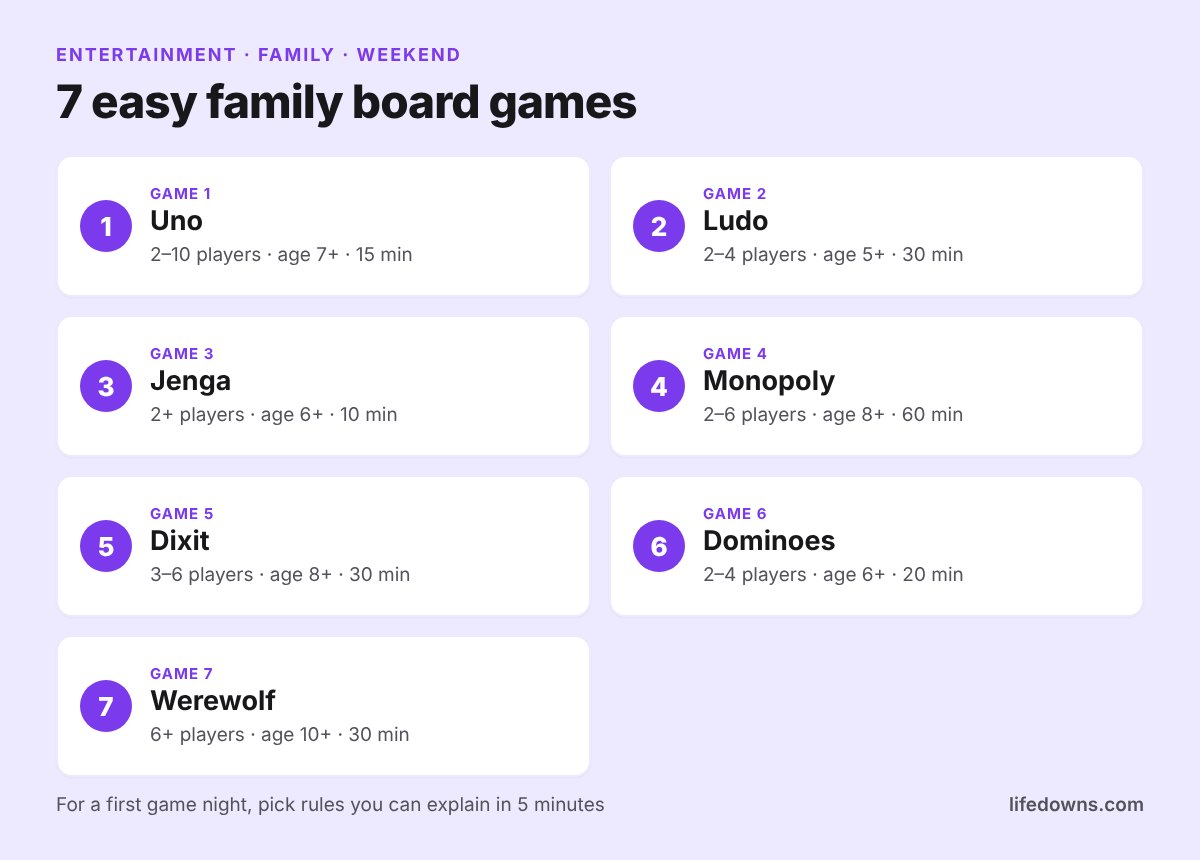
| Game | Players | Age | Time |
|---|---|---|---|
| Uno | 2–10 | 7+ | 15 minutes |
| Ludo | 2–4 | 5+ | 30 minutes |
| Jenga | 2 or more | 6+ | 10 minutes |
| Monopoly | 2–6 | 8+ | 60 minutes or more |
| Dixit | 3–6 | 8+ | 30 minutes |
| Dominoes | 2–4 | 6+ | 20 minutes |
| Werewolf | 6 or more | 10+ | 30 minutes |
Note: Player counts, ages and times are a general guide and can vary by edition; check the details on the box.
Tips for a fun game night
- Pick a fixed evening each week so it becomes a habit.
- Leave phones in another room while you play.
- Prepare some fruit or light snacks.
- Let the children choose the game and read the rules aloud.
- Praise good sportsmanship, not only the winner.
5. Summary: start with one really simple game
Family board games do not need to be expensive or complicated. Start with a short-rules game such as Uno or Jenga, play for 30 minutes on Saturday night, then try new games over time. The best part is not who wins, but that everyone sat down together.
More in Entertainment: Weekend Picnic Checklist: 7 Easy Steps to Plan a Fun, Stress-Free Day Outdoors and Find Good Podcasts You Will Actually Love: 6 Simple Ways to Turn Dead Time Into Great Entertainment.
Frequently asked questions about family board games
Which family board games suit children under 6?
Ludo, Jenga and dominoes are the easiest choices because the rules are short and no reading is needed. An adult should play along to guide them.
What can we play with only 2 people?
Uno, Jenga, dominoes and Ludo all work well with 2 players.
How long should a game night last?
About 30–60 minutes is ideal. Stop while everyone is still having fun so they look forward to the next one.
How do I help a child who gets upset about losing?
Choose games with some luck, play in teams, and remind them that winning and losing are part of the game. Adults can set an example by losing cheerfully.
Which game does your family love most? Share your favourite family board games in the comments so other readers can try them too! 🎲